


Express Asphalt solutions
Commercial Asphalt Paving in Tampa Bay
We pave, resurface, and repair commercial parking lots and paved surfaces across the Tampa Bay area and the surrounding six counties: Pasco, Pinellas, Hillsborough, Hernando, Citrus, and Polk.
Founded in 2023, Express Asphalt Solutions has delivered more than 875,000 square feet of commercial paving, including three active hospital campuses that stayed open to patients and staff throughout the work. That is the kind of experience that tells you how to sequence a job so it does not shut down your operation.
This page walks through exactly what asphalt paving involves. Every step, every material choice, every reason things go wrong when someone skips a step. If you are shopping paving contractors, use this as your reality check on the bids you are getting.
When you are ready for a written estimate, call (727) 293-4431 or request one online.
Asphalt Paving Services in Tampa Bay, FL
How to tell if your lot actually needs paving
Not every problem needs a full paving job. Sometimes patching is enough. Sometimes sealcoating buys you five more years. Here is how we sort it out on a site visit, and how you can spot the difference yourself.
Signs you need a full repave or mill-and-overlay
- Alligator cracking across a big area. Connected cracks in a scaly pattern mean the base underneath has failed. Patching a section will not fix it. The failure will spread.
- Standing water more than 24 hours after rain in the same spot every storm. Grade problem. Only fix is to remove and re-lay.
- Potholes wider than 12 inches or deeper than 4 inches in more than one spot. Individual patching becomes throwaway money once the pattern is site-wide.
- Faded, flaking surface with a gray, weathered look and no visible oil. The binder is oxidized out. Sealcoating will not bring it back at this stage. Overlay is the right call.
- Lot age over 20 years without prior overlay work. Even well-maintained lots have a lifespan.
Signs sealcoating or patching is enough for now
- Isolated small cracks under 1/4 inch wide. Crack sealing with hot rubberized filler handles these.
- A few isolated potholes with an otherwise intact surface. Targeted patching work.
- Surface looks dull but no cracking or standing water. Sealcoating restores color and adds protection.
When in doubt, we come out and tell you the truth. If sealcoating is what you need, we will tell you sealcoating. We do not upsell paving jobs on lots that do not need them.
Our commercial paving process, step by step
Every commercial paving job we run follows the same sequence. Here is what happens, why each step matters, and what goes wrong when someone rushes it.
Step 1: Site assessment and written estimate
We walk the property, measure square footage, check drainage, take core samples if we suspect base issues, and identify utilities. You get a written scope of work, materials specified, timeline, and price before we mobilize. No verbal estimates. No surprise change orders unless we hit an unknown subsurface condition, and we tell you before we act.
Step 2: Demolition and removal
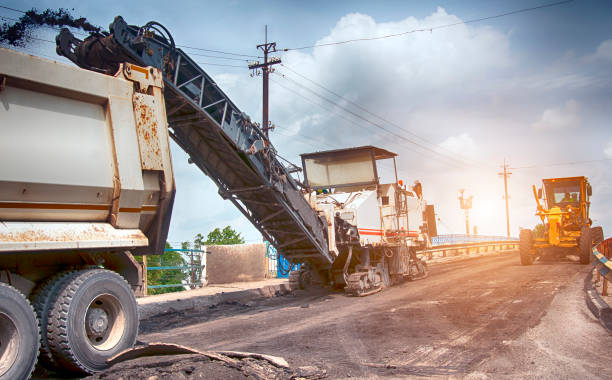
Existing pavement gets removed with milling machines, front loaders, and dump trucks. We haul the old asphalt to a Florida asphalt plant where it gets recycled into new mix. Recycled asphalt pavement (RAP) is as strong as virgin material when it is processed correctly, which is why the industry standard now runs 20 to 30 percent RAP content in new mix.
Step 3: Base preparation and grading
This is where most cheap paving jobs cheat. The base underneath your asphalt is what carries the load. If it is not compacted right, or if it is not graded to drain water off the surface, your new asphalt will fail within 3 to 5 years no matter how good the top layer looks on day one.
We use automatic motor graders and laser-guided transits to shape the base. In Tampa Bay that grading matters more than most places. Our summer storms drop 3 to 6 inches of rain in a single afternoon. If water pools instead of running off, freeze/thaw is not the failure mechanism here, but repeated saturation and softening of the base is. Water sitting on top of asphalt does not just look bad. It shortens the pavement life dramatically.
Step 4: Sub-base repairs and proof rolling
Before we add new asphalt, we proof-roll the base with a loaded quad-axle dump truck to expose any soft spots. Weak areas get excavated, filled with crushed limestone or crushed concrete, and re-compacted. This step gets skipped constantly by low-bid contractors. If your base has a soft spot and you pave over it, you get a pothole within a year.
Step 5: Binder course and surface course
The binder course is a coarse aggregate mix that provides structural support. The surface course is a finer mix that gives you the smooth driving surface. In Florida commercial applications we typically place 2 to 3 inches of binder and 1 to 1.5 inches of surface for parking lots, more for truck routes and drive lanes.
Step 6: Compaction and joint work
The final compaction is done with steel drum rollers immediately after paving while the mix is still hot. Density targets are 92 to 96 percent of maximum theoretical. Anything under 92 percent means the mat will unravel within a few years.
Butt joints where new asphalt meets existing pavement (curbs, driveways, adjacent lots) get tack-coated and hand-worked to make a smooth transition. This is craft work. Rushing joints is why parking lots have those visible ridges that catch shopping carts and grocery bags.
Step 7: Striping and marking
Once the asphalt has cured 24 to 72 hours depending on temperature and thickness, we come back for pavement marking and striping. Fresh paint on fresh asphalt lasts significantly longer than paint applied to weathered surface.
Types of commercial paving work we do
New construction paving. Ground-up parking lots for new commercial buildings, warehouses, retail centers. We coordinate with general contractors and typically get called in after site prep and utility work is complete.
Full-depth reconstruction. When the base has failed and overlay will not solve the problem, we remove everything down to sub-grade, rebuild the base, and repave. Expensive but sometimes the only real answer.
Mill-and-overlay. We mill off the top 1.5 to 2 inches of existing asphalt, do any needed base repairs, and lay new surface course. Costs about 40 percent less than full reconstruction and buys you 10 to 15 years if the base is still sound.
Overlay only. For lots that are still structurally sound but starting to show surface wear. We tack-coat the existing surface and lay 1 to 1.5 inches of new asphalt. Fastest option, but only appropriate when the base and existing pavement are in good condition.
Asphalt patching and pothole repair. For isolated failures on an otherwise good lot. Available as a standalone service through our Express Pothole Repair booking system at expresspotholerepair.com.
Parking lot expansion. Adding new paved area to an existing lot, tying into existing pavement with proper joint work.
Florida climate factors we plan around
Tampa Bay asphalt lives a different life than asphalt in Ohio or Pennsylvania. We work around three big factors that shape every paving decision.
Heat. Florida summer surface temperatures on new asphalt hit 140 to 160 degrees. Fresh mix needs to be laid hot (275 to 300 degrees at the paver), then compacted quickly before it cools. Compaction has to be finished before mix temperature drops below 175 degrees. This is why afternoon rain storms during summer can force us to reschedule a job. Rain on hot fresh asphalt ruins the surface.
Hurricane rain and flooding. A single tropical system can drop 6 to 15 inches on a lot in 48 hours. Grading and drainage are life-or-death for asphalt longevity in our climate. Standing water is the number one killer of Florida parking lots.
UV degradation. Florida sun oxidizes the binder in asphalt faster than northern climates. A new lot that is never sealcoated will start losing binder within 3 years. This is why we recommend sealcoating every 2 to 3 years after the first 12 months.
Salt spray on coastal work. Lots within a mile of the water take extra chemical wear. We use higher-binder-content mixes for coastal properties.
Timeline and business disruption
A typical 10,000 square foot commercial parking lot paving job runs 3 to 5 business days from start to reopen. Here is how the schedule breaks down.
- Day 1 morning: Barricade, close section, start demolition and milling
- Day 1 afternoon: Complete demo, begin base repair
- Day 2: Finish base work, proof roll, mobilize paving crew
- Day 3: Pave (typically one continuous mobilization for a lot this size)
- Day 3 to 4: Curing period. Asphalt is walkable within hours, drivable within 24 hours, ready for heavy loads at 72 hours
- Day 4 to 5: Return for striping once surface is fully cured
How we keep your business operating. Most commercial paving jobs get phased. We work one zone at a time, keep the rest of the lot open, and move barricades on a schedule you approve in advance. Our largest project (271,000 square feet at an active hospital) ran zone-by-zone across 5 weeks without a single day of closure to patients or emergency services. See our commercial paving page for more project examples.
If your operation cannot tolerate any daytime work, we do overnight and weekend paving. Premium pricing, but zero disruption.
Frequently asked questions
How long does new asphalt take to cure?
Walkable in 4 to 6 hours. Drivable with cars in 24 hours. Ready for heavy commercial traffic and trucks in 72 hours. Full cure (chemically stable) takes 30 days, which is why we recommend waiting 30 days before the first sealcoat application.
What is the difference between paving, sealcoating, and patching?
Paving is new asphalt installation or replacement. Sealcoating is a thin protective coating applied to existing asphalt to seal out UV and moisture. Patching is targeted repair of isolated failures. A well-maintained parking lot gets paved once every 20 to 25 years, sealcoated every 2 to 3 years, and patched as needed. See our sealcoating page for details.
Do you work around open businesses?
Yes, that is most of what we do. We phase work by zone, keep the rest of the lot open, and coordinate barricades and access with your operations team. Our commercial project experience includes hospitals that stayed fully open to patients during 271,000 square feet of work.
How long should a properly paved commercial lot last?
20 to 30 years if the base is sound, drainage is right, and it gets sealcoated on schedule. 8 to 12 years if any of those three get skipped. The difference is entirely in the prep and the maintenance.
Contact us for a free project estimate
"*" indicates required fields
Browse More Services
Express Asphalt Solutions has decades of asphalt, concrete, and maintenance experience across a wide range of markets.

Pavement Marking and Striping
Introduce some order to the chaos of your unmarked lot with Express Asphalt Solutions parking lot marking.

Paving
Asphalt pavement is utilized in a variety of different applications.

Cracksealing
Cracksealing halts the spread of existing cracks and increases the overall lifespan of your pavement.

Sealcoating
A sealcoat consists of either coal tar pitch or asphalt cement mixed with inert fillers, water or additives.